Abstract
Higher education institutions in developing countries, especially in Africa, face numerous challenges related to the massification of classes due to rapid growth in student enrollment in public universities. This expansion has been encouraged by public authorities, with the support of organizations like the United Nations and UNESCO, to ensure that countries can train qualified professionals and meet their socio-economic needs. However, the increase in student numbers in large classes (with some courses having over 3,000 students) raises significant concerns regarding the quality of education and equity. Issues include resource availability, content reproducibility, study conditions, and access to digital solutions. Providing this type of education requires specialized training conditions and infrastructure, which is often lacking in developing countries. This paper presents the findings of a survey conducted at the University of Lomé, which included 1,800 students and 106 teachers, all of whom experience the challenges associated with large class sizes. The student demographic primarily consists of first-year bachelor’s program entrants. The main objective of the survey is to gather insights and opinions from participants on suitable solutions the University of Lomé can implement to address the challenges of massification when enrollment exceeds 3,000 or 4,000 students. Additionally, the study aims to consider the perspectives of stakeholders in higher education to propose an ICT-based solution for managing large groups effectively. The findings of this research can also be applied to other African universities facing similar challenges and may pave the way for solutions akin to intelligent classrooms for face-to-face courses.
Keywords
Massification, Large Classes, Smart Classroom, Face-to Face Courses, ICT-based Solutions
1. Introduction
In many developing countries, the massification of higher education is a major challenge for public universities. Student enrollments continue to grow rapidly, with over 3,000 students in some courses that require special teaching conditions and infrastructure.
In line with the United Nations' Sustainable Development Goals (SDGs) and the involvement of UNESCO (United Nations Educational, Scientific and Cultural Organization), efforts are underway in many African countries to provide quality university education to their populations. This study's findings, which propose innovative solutions such as IT-based solutions combined with connected smart classrooms to achieve training quality and equity (availability of resources, reproducibility of content, access to digital solutions, student study conditions, etc.) for face-to-face courses, hold immense promise for the future of higher education in Africa. They are not only relevant but also crucial for training senior executives capable of addressing sustainable development challenges and meeting the requirements of financial institutions such as the African Development Bank (ADB), the International Monetary Fund (IMF), and others.
Since the early 1970s, African countries have established public universities to meet these development demands and the Council of 19 African States for Higher Education
. However, their numbers remain insufficient, which has led to the emergence of private higher education institutions in several countries. The costs of these private institutions are significantly higher compared to the socio-economic profiles of their students. They also face criticism due to unsuitable teaching content and inadequate competence among their academic teams.
As a result, African public universities must cope with large classes of (5000 or more) entry-level students. Public institutions are struggling to manage this high demand with limited available resources. The teaching teams' resources must be substantial and include additional technical resources to cope with the high demand.
Many universities have responded to this challenge by building large classrooms that can accommodate 1,000 or more students, or alternatively offering distance learning classes for large numbers of students. Solutions based on large lecture theaters are inadequate, as the capacity of classrooms cannot be increased indefinitely without posing new problems for audience management. On the other hand, distance learning raises new issues from the point of view of students and teachers. These problems must be carefully studied to identify suitable solutions, including access to resources, motivation, student monitoring, and certification of prior learning
| [2] | Jézégou, A., La formation à distance: enjeux, perspectives et limites de la formation à distance, Paris édition Harmattan, 1998. |
| [3] | Al Siyabi, M., A. A. Khan, T. Hussain, H. Al Rashdi, and J. R. Pillai. "Evaluating the Impact of E-Learning and Online Assessment on Engineering Education in Oman HEIs during COVID-19: A Mixed-Method Study." Journal of Educational Research and Reviews 12, no. 1 (2024): 1-11. https://doi.org/10.33495/jerr_v12i1.23.143 |
[2, 3].
2. Scope and Objectives
In the remainder of the paper, we use the case of the University of Lomé in Togo to illustrate the issues of class massification and discuss the particular solution adopted by the university in response to this problem. The University of Lomé (UL) is a large public institution, with 70000 undergraduate students and about 3000 graduate students at year 2024. It has 600 academic and 1478 non-academic employees. The University of Lomé faces a growing demand for higher education from graduating high school students. These demands stem from the need to achieve sustainable development in compliance with the United Nations sustainable development goals (SDG4)
| [4] | Tepe K., Yetongnon K., The role of ICT in scientific research for sustainable development, jrsul, 08-13 October 2018. |
| [5] | Pierre-Jean Loiret, L'université virtuelle africaine, l'enseignement à distance en trompe-l'œil? Distances et savoirs, 2008, 6(2), 187-209. https://doi.org/10.3166/ds.6.187-209 |
[4, 5]
, to train high-quality senior executives. At the University of Lomé, the large teaching units are typically in the faculties (schools) of humanities, economics, and law. About 5000 students enroll annually in the first-year academic programs.
Table 1 below presents the enrolments in these faculties over 13 years. It highlights the uneven distribution of large numbers of students across the different programs.
Table 1. Evolution of semester 1 enrolments at UL over ten academic years in the faculties of language, science, economics, and Law (academic data of University of Lome, 2024).
Type of faculty or school | AY 2012 | AY 2013 | AY 2020 | AY 2021 | AY 2022 | AY 2023 | AY 2024 |
Literature, Languages and Arts | 2 919 | 3 153 | 5 085 | 4932 | 5 480 | 5822 | 5933 |
Economics and Management | 2 620 | 3 273 | 5 415 | 7080 | 6 270 | 7491 | 7653 |
Law | 3 876 | 2 246 | 2 772 | 2828 | 2 921 | 3880 | 3574 |
Science | 2 290 | 1 877 | 3 083 | 4019 | 3 347 | 3765 | 3812 |
Currently, the University of Lomé has implemented several measures to facilitate teaching large groups. They are mainly based on increasing the material infrastructure and human resources. For example, we can mention work on hardware and digital infrastructures, such as constructing several large amphitheaters (1000 to 1500 seats) or installing a strong wireless campus network to bring together several Togolese universities and hospital centers to share resources. So, students at different sites can access the Internet via a single account.
Lomé University also set up courses in parallel sessions for high-demand teaching units by hiring more teachers to repeat classes (parallel sessions). This solution requires harmonizing the content followed by different audiences for the same curricula.
Following the experience of the COVID-19 pandemic, the university tried to deploy online courses and even teaching sequences in hybrid mode. However, this solution, which has been tried and tested in many countries, requires each student to be fully equipped with computers and a stable, high-quality Wi-Fi network.
In some teaching units, the current 1000 and 1500-seat lecture rooms do not have enough seats for all the students, who constantly compete for the available places.
This paper presents the results of a survey conducted among several faculties experiencing large class problems at the University of Lomé. With voluntary and anonymous participation, the survey involves 1800 students and 106 teachers. The student demographic consists of students from the bachelor programs, with a majority of first-year entry-level students most concerned with the large class problems. The study's main objective is to collect the participants’ input and opinions on the appropriate solutions to implement by the University of Lome to address the challenges of massification when entry-level enrollments exceed 3000 or 4000 students. It aims to consider the views of higher education stakeholders in public universities to provide an ICT-based solution for managing large groups. The findings of this study can be extended to other African universities with similar needs and open the way for a solution analogous to intelligent classrooms for face-to-face courses.
3. Literature Reviews
Several large-scale international and national projects have been proposed to improve the capacity of African universities to meet the growing demand for higher education. These projects, generally based on ICT tools, aim to overcome the lack of infrastructure, teaching resources, and qualified teachers in specific fields. Most of these projects have not produced the expected results, and new pedagogical methodologies for mass training are being sought all over the world
| [2] | Jézégou, A., La formation à distance: enjeux, perspectives et limites de la formation à distance, Paris édition Harmattan, 1998. |
| [6] | Karsenti, T., & Savoie-Zajc, L. (Dirs.). (2018). La recherche en éducation: étapes et approches (4ᵉ éd.). Montréal: Presses de l'Université de Montréal. https://doi.org/10.1515/978276063933 |
| [7] | Mitchell, A. (2014). Online Courses and Online Teaching Strategies in Higher Education. Creative Education, 5(23), 2017-2019. https://doi.org/10.4236/ce.2014.523225 |
| [8] | Arbaugh, J. B., & Rau, B. A Study Disciplinary, Structural, and Behavioral Effect on Course Outcomes in Online MBA Courses. Decision Sciences Journal of Innovative Education, 2007. 5(1), 65-95. |
[2, 6-8]
.
Many mass training models centered on information and communication technologies have been investigated. E-learning and MOOCs (Massive Open Online Courses) offer training courses to a target audience that can follow the course individually or collectively. Several prestigious universities have adopted these new educational technologies to offer online, fee-based training courses equivalent to the degree courses offered by these institutions in initial training
| [9] | Hone, K. S. and El Said, G. R. (2016) Exploring the Factors Affecting MOOC Retention: A Survey Study. Computers and Education, 98, 157-168. https://doi.org/10.1016/j.compedu.2016.03.016 |
| [10] | Wu, B. and Chen, X. (2017) Continuance Intention to Use MOOCs: Integrating the Technology Acceptance Model (TAM) and Task Technology Fit (TTF) Model. Computers in Human Behavior, 67; 221-232. https://doi.org/10.1016/j.chb.2016.10.028 (Wu et al., 2017) |
| [11] | Margaryan A., Manuela B., Allison L., Instructional quality of Massive Open Online Courses (MOOCs), Computers & Education, Volume 80, 2015, Pages 77-83. https://doi.org/10.1016/j.compedu.2014.08.005 (Margaryan et al., 2015) |
[9-11]
. As part of the United Nations ODD4 initiative, the International Institute of Online Education uses new technologies to provide learning platforms for higher education teachers. IIOE (www.IIOE.org) is a global initiative created by UNESCO-ICHEI in collaboration with higher education partner institutions in China and other developing countries in Asia-Pacific and Africa as well as corporate partners. It aims to build the capacity of the partner institutions and expand access to higher quality education. The target audience for MOOCs and e-learning may include professionals or self-taught individuals who can tailor courses to suit their availability. Examples of popular MOOCs include Coursera (www.coursera.org), Stanford (www.Stanford.edu), and MIT (www.mit.edu). Some courses lead to professional certificates, such as those issued by ORACLE (www.oracle.com), CISCO (www.cisco.com), Microsoft (www.microsoft.com), etc.
In response to the class massification problems, many countries have developed virtual universities and other video-based mass approaches. Virtual universities allow large groups to access high-quality university training at a low cost. At the international level, several large-scale projects were proposed in the 90s, notably the African Virtual University (AVU) project, initiated by the World Bank and the ADB
. The pedagogical model is based on creating learning centers in African institutions, from which learners can follow a selection of courses given in the partner institutions via the Internet. In a similar vein, the CVA project (African Virtual Campus piloted by UNESCO and its partners), launched in November 2008, aims to bring together 5 West African countries (Benin, Cape Verde, Côte d'Ivoire, Gambia, and Senegal) to provide the sub-region with a joint program through a network of online production and teaching centers in West Africa (with a precise model for copyright and intellectual property). This project failed to deliver the expected results
| [12] | Vigliano, Patrick. "Du Campus Virtuel Avicenne au Campus Virtuel Africain de l'UNESCO." In CFM 2009-19ème Congrès Français de Mécanique. AFM, Maison de la Mécanique, 39/41 rue Louis Blanc-92400 Courbevoie, 2009. |
[12]
. UoPeople (www.uopeople.edu) is a private virtual university set up in 2009 in partnership with several American and Canadian universities, offering a limited number of bachelor's and master's degrees in business, health science, education, and other fields. The teaching methodology is based on online course delivery to groups of 20 to 30 students, assisted by an instructor. Registration fees are virtually free, and the resources required (books, videos, recordings, etc.) for the courses are provided via the OER (Open Educational Resources, www.oercommons.org) and (www.unesco.org) sharing platforms. At the national level, several projects have been proposed, including the virtual universities of Senegal (www.uvs.sn), Zimbabwe (www.zou.ac.zw), Pakistan (www.vu.edu.pk), and India (www.study badshah.com).
Finally, videoconference-based training gained popularity during the COVID-19 health crisis, enabling institutions worldwide to maintain acceptable training programming and delivery. Video Conferencing tools (ZOOM, TEAMS, MEET, WEBEX, etc.) have made it possible to move course programming into a virtual space that learners can access collectively from different locations. These solutions have met with some success but require further study and analysis to determine whether the level of teaching and assessment is comparable to that of traditional training. MOOCs and e-learning are distance learning courses aimed at the general public and offering resources for acquiring new knowledge and developing personal or professional skills
| [13] | Haipinge E., Kadhila N., Rethinking A Framework for Contextualising and Collaborating in MOOCs by Higher Education Institutions in Africa, Journal of Learning for Development, (March 2021), Vol. 8, No. 1, pp. 204-220, ISSN: 2311-1550. |
[13]
.
The literature review shows that the massification problem, namely teaching large classes, has been largely recognized, and various solutions have been proposed. This problem is not confined to the public universities in Togo. Several developing countries have similar problems, and the research has explored different approaches in which distance learning is a key feature. However, to our best knowledge, little research has been directed to the massification problem involving large groups whose size exceeds 3000 or 4000 students. This raises many research questions:
RQ1: Can ICT tools be used to provide a solution to managing large groups?
RQ2: What form might this solution take, taking into account the opinions of learners and teachers?
4. Study Methodology
The study methodology is a survey to collect data and analyze the effectiveness of the methods used by the University of Lomé to manage large student classes. The survey was carried out in the faculties with an annual enrollment of 3000 or more, as shown in
Table 1. 1800 students and 106 teachers participated. The student demographic consists of students from the bachelor programs, with a majority of the first-year entry-level students most concerned with the large class problems. Participation for both teachers and students is voluntary, and the responses were anonymous. The study adopted a mixed-method approach, combining open interviews and questionnaires to obtain quantitative results. The questionnaires also include open and closed questions for students and teachers. The interviews were conducted to collect qualitative information that teachers and students would not have provided in the survey forms.
4.1. Teacher Survey Questions
This survey is used to determine how the teachers interacted with large groups and to understand how they had invested in the various distance learning solutions implemented during the COVID period. Note that, as the teachers' profiles varied widely (tenured, part-time, industrialists, etc.), the questionnaire began with questions designed to define each respondent's profile.
The questionnaires are categorized (C1 to C6). C1 to 5 contain information about the teacher and their opinion on managing a large group of students with the existing solutions, particularly his or her university of origin, experience in managing large groups, and opinion on existing solutions (C1 to C4). C3 provides more details on the difficulties encountered in managing large groups and the solutions proposed at the University of Lomé, particularly the construction of amphitheaters with a larger capacity or the division of students into small groups with repeated sessions for the groups. C5 provides opinions on the solutions applied during the COVID period, i.e., distance learning with videoconferencing solutions, face-to-face courses, and hybrid solutions. The C6 was used to obtain opinions on the need to find better management solutions for large groups based on ICT tools and with the possibility of considering the experience acquired in face-to-face and distance learning courses.
4.2. Student Survey Questions
Student surveys focused mainly on transitioning from high school to university regarding working conditions (group size, relationship with the teacher, personalized student support, etc.). An essential part of the questionnaire focused on their connection tools (network quality, computer equipment for taking courses, etc.) and their ability to have a suitable workspace when taking distance learning courses.
The student questionnaires are organized into 3 categories. The C1 collects information about the students, particularly their university of origin, age, course of study, and degree they are pursuing. The C2 collects their impressions of university studies, whether they belong to large training groups, and how they feel about this situation where everyone has to organize themselves to succeed. The C3 asks for their opinion on the distance learning solution proposed as an alternative. It asks whether they have the technical resources and training required to access online courses and whether they have the required environment and workspaces to access these online courses without worry. Some questions proposed multiple choices for answers, and others are open questions.
5. Results and Interpretation
The student surveys were sent to 1,800 undergraduate students, most of whom had attended several lectures in large groups. The teacher surveys were sent to 106 teachers with experience teaching large groups. Moreover, many informal interviews were carried out to provide qualitative information to complement the survey results. The data collected included 1702 responses from students and 86 responses from teachers. Below, we discussed and analyzed the teachers' responses in section 5.1. In addition to the teacher survey questions, 70 open interviews were conducted with teachers selected from the list of large group courses. The discussion and analysis of student responses are presented in section 5.2.
5.1. Analysis of Teachers Survey Responses
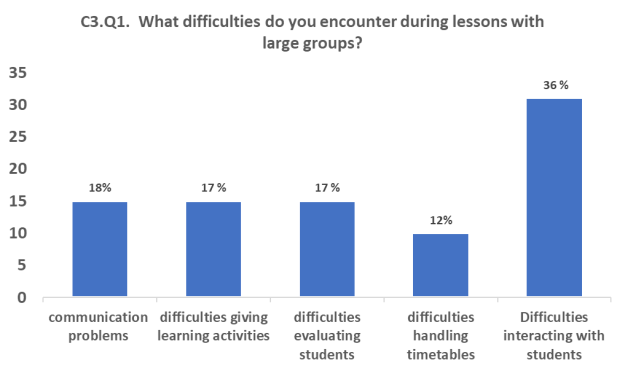
Of 106 teacher surveys sent out, 86 responses were received. Most teachers are from public universities in Togo and have already given lectures to groups of 1000 or more students. The C3 addresses the difficulties involved in teaching large groups. The responses range from having general communication issues (18%) to specific difficulties interacting with the students (36%) (
Figure 1). Many teachers report difficulties engaging in learning activities (17%) or evaluating the students (17%). Finally, 12% experienced administrative and organizational difficulties, particularly in the management of class hours.
Figure 1. Teacher Survey response to C3.Q1.
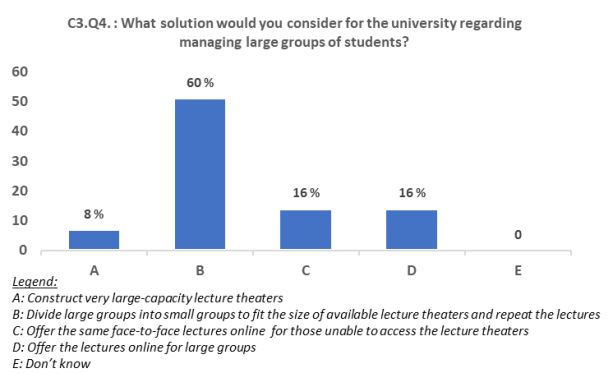
When asked what would be an appropriate solution to be implemented by the university to manage large groups, 60% of the survey respondents favor dividing large groups into smaller ones for lecture sessions. 16% favor giving the courses online only. Another 16% of respondents agree with a solution that would teach face-to-face courses and offer the same courses online for students who couldn't access the lecture halls (
Figure 2). During informal interviews about online courses, many teachers raise several issues and concerns ranging from the technological problems associated with protecting access to copies of course materials available online to authorizing only students enrolled in these courses to listen and view the recorded sessions. They also raise issues about acquiring and mastering the ICT tools required by distance courses. Other studies have discussed similar issues
| [14] | Erstad, Ola, Susanne Kjällander, and Sanna Järvelä. "Facing the challenges of ‘digital competence’ a Nordic agenda for curriculum development for the 21st century." Nordic Journal of Digital Literacy 16.2 (2021): 77-87. https://doi.org/10.18261/issn.1891-943x-2021-02-04 |
[14]
. For example, a previous work
| [15] | Tondeur, J., van Braak, J., Ertmer, P. A. et al. Understanding the relationship between teachers’ pedagogical beliefs and technology use in education: a systematic review of qualitative evidence. Education Tech Research Dev 65, 555–575 (2017). https://doi.org/10.1007/s11423-016-9481-2 |
[15]
proposed a set of basic technological skills test tools in teacher recruitment in Belgium.
Figure 2. Teacher Survey response to C3.Q4.
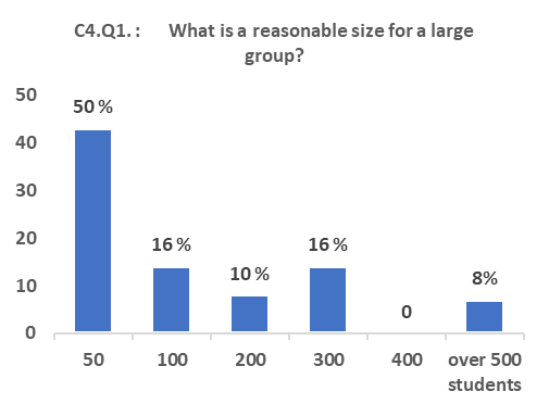
When asked what the acceptable group size should be, 92% (
Figure 3) of the respondents said a group size of 300 or less is acceptable. More precisely, for 50% of those surveyed, a reasonable size for a large group would be 50 or fewer students; 16% thought a large group should contain 100 students, and the same percentage favored groups of 300. Only 8% of the respondents are for groups of 500 or more students.
Figure 3. Teacher survey response to C4.Q1.
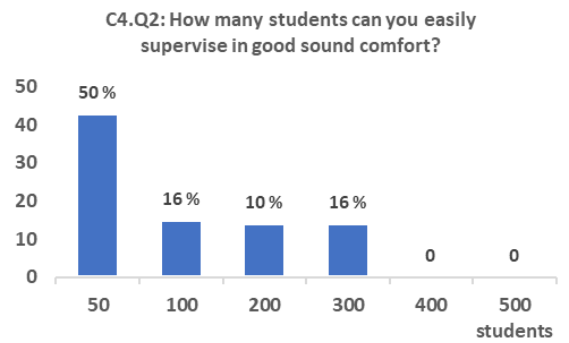
When the audio comfort in the lecture room is considered, 43 (50%) of the surveyed prefer a group size of 50. Meanwhile, 15 (18%), 14 (16%), and 14 (16%) favored group sizes of 100, 200, and 300, respectively (
Figure 4). Regardless of the sound level in the lecture room, the percentages are similar to those of the previous question, suggesting that sound comfort is an important factor in determining acceptable group sizes. Furthermore, this idea is confirmed by informal discussions with many participant teachers, which led to the conclusion that, for practical purposes and skills assessment, the size of student groups that can be easily managed should not exceed 50 learners.
Figure 4. Teacher survey response to C4.Q2.
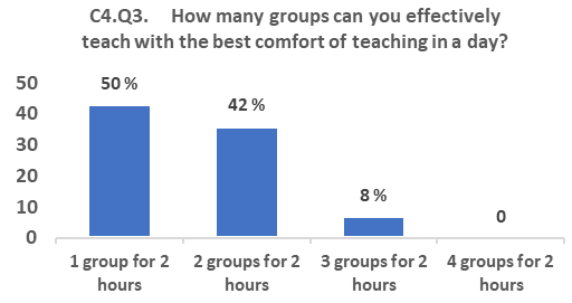
Regarding the number of groups that can be taught effectively in a day by a teacher, 50% of the surveyed agreed on teaching one course for 2 hours a day, while 42% would accept teaching 2 different groups a day for 2 hours each. 8% favor teaching 3 groups a day. No favorable responses for teaching more than 3 groups in the same day (
Figure 5). During informal discussions, most teachers who had already repeated the same lessons in different sessions felt that the content of the lessons was never identical. Indeed, students' questions could lead to other developments in some sessions, and sometimes fatigue or good humor can also lead to not faithfully giving the same lessons in different groups.
Figure 5. Teacher survey response to C4.Q3.
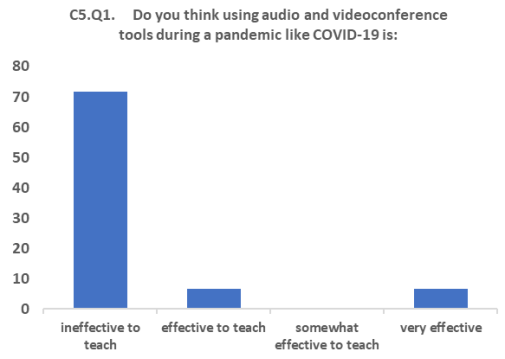
The C5 address teachers' views on distance learning. 84% of the survey affirmed that the distance learning arrangements implemented during the coronavirus pandemic were ineffective (
Figure 6). During informal interviews and discussions following the survey, many teachers complained about being unprepared to provide good quality distance learning lectures. Some face-to-face practices were used online with mitigated results. For example, teachers tried to control class attendance of remotely connected students by dictating lectures or interrogating students using virtual classroom ICT tools such as Discord. They also uploaded materials to the Moodle website for access and appointments for live exchanges. Teachers also had difficulty adapting their traditional teaching practices to distance-learning ICT tools, as in similar cases elsewhere.
| [16] | Blume, C. (2020). German teachers'digital habitus and their pandemic pedagogy. Post Digit Science Education, 2, 879-905. https://doi.org/10.1007/s42438-020-00174-9 |
| [17] | Greenhow, C., & Lewin, C. Online and blended learning: Contexts and conditions for education in an emergency. British Journal of Educational Technology, 2021, 52(4), 1301-1305. |
| [18] | Oliveira, G., Teixeira, J. G., Torres, A., & Morais, C. An exploratory study on the emergency remote education experience of higher education students and teachers during the COVID-19 pandemic. British Journal of Educational Technolgy, 2021, 52(4), 1357-1376. https://doi.org/10.1111/bjet.13112 |
[16-18]
.
Figure 6. Teacher survey response to C5.Q1.
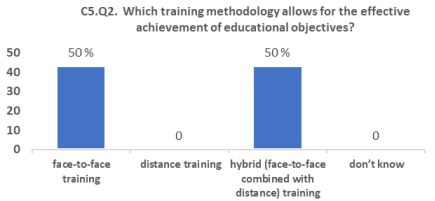
To effectively achieve the pedagogical objectives of large group teaching, 50% believe that some level of face-to-face training is needed, and 50% believe that face-to-face training should be combined with distance learning (i.e. a hybrid system) (
Figure 7).
Figure 7. Teacher survey response to C5.Q2.
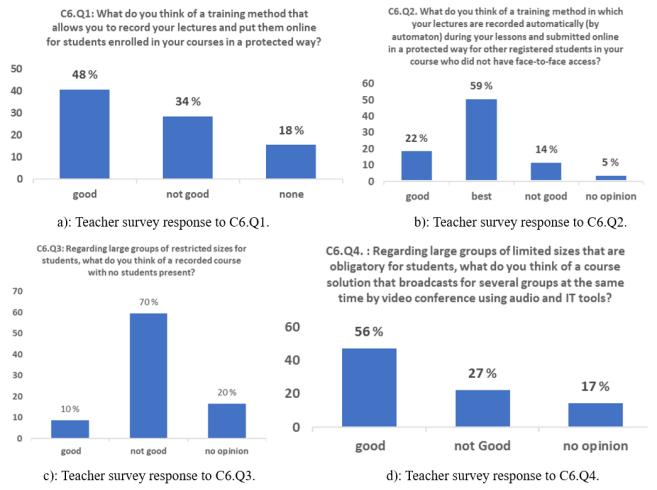
The C6 of the questionnaire survey sought teachers' views on new ICT-based solutions for managing large groups. Respondents thought it was a good idea to record courses and offer them online to registered students with a level of control or protection. 81% (
Figure 8b) of respondents would like courses to be recorded by an automatic recording machine in front of a live student audience. 66% (
Figure 8a) of respondents were not against making course materials available online. Concerning the recording and distribution of course materials, 70% of respondents did not support the idea of distributing materials produced without the presence of students (
Figure 8c). On the other hand, 73% of respondents favored the simultaneous broadcasting of courses by videoconference to several groups of students (
Figure 8d).
Figure 8. Teacher survey response to category C6 questions.
In summary, the results of the teachers' surveys show that the problem of large groups of students is a reality that will continue for some time and that solutions must be found. These solutions must take into account the possibilities of teaching in small groups to improve teaching practices (teaching, dialogue with learners, assessment, etc.) but also the ability of teachers to reproduce the same teaching for different groups in staggered sessions and the number of these lessons which must not exceed 2 sessions of 2 hours in the same day. The teachers did not support recording lectures online without students' presence. However, they favor combining face-to-face and distance learning lessons and ICT-based solutions that use automatic recording machines for reusable. They also favor videoconferencing solutions, combining classrooms with the best audio, video, and ICT facilities.
5.2. Analysis of Students Survey Responses
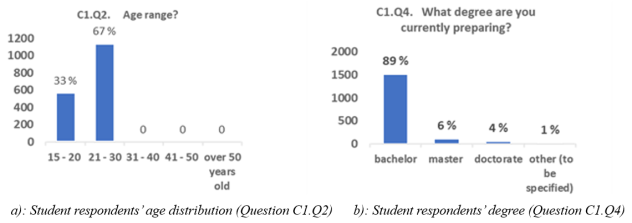
From a total of 1800, 1702 student survey responses were returned. The survey is composed of 3 categories, which comprised 4, 6, and 10 questions, respectively. Most of student respondents are from the major public institutions in Togo; 67% of the respondents are in the 15-20 years range, and 33% are in the 21-30 years range (
Figure 9a). A majority (1513 or 89%) of students are enrolled in a Bachelor's program, 112 (6%) students are in a Master's program, and 65 (4%) are doctoral students (
Figure 9b). The challenges and management issues related to the large groups are often at the first or second-year levels of the bachelor program. Thus, some students may have faced difficulties in attending lectures in large groups one or two years before responding to the survey.
Figure 9. Student survey, personal information and degree.
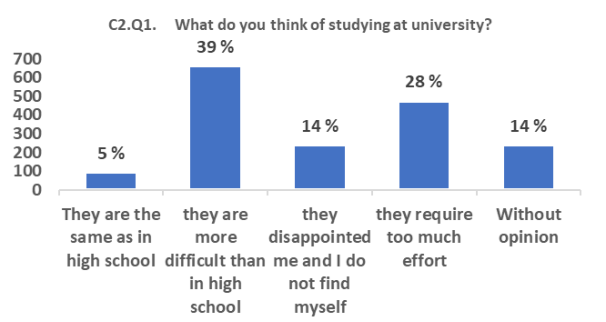
The students were questioned on the challenges of university studies as opposed to high school education. 67% of the respondents find university education more difficult (39%) and requires more effort (28%) than their high school formation. 14% of the respondents were disappointed by the university and had difficulty adjusting to new teaching methods. Only 5% of the students find the difficulties of attending large groups similar to attending high school, and 14% have no opinion on the question (
Figure 10).
Figure 10. Student survey, opinion on university studies (question C2.Q1).
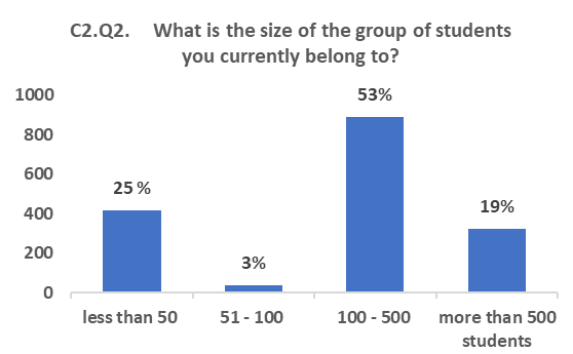
Only 25% of the respondents currently belong to groups of 50 or fewer students, while 72% are members of groups of 100 or more students (
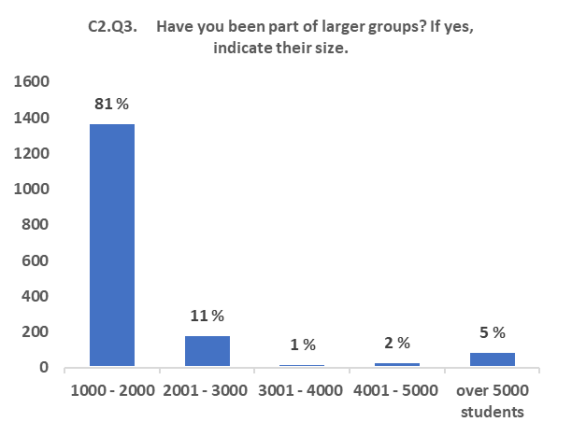
Figure 11). 81% of respondents are in groups with sizes between 1000 and 2,000. 11% are in groups between 2000 and 3000 students, and 8% are in groups with sizes exceeding 3000 students (
Figure 12).
Figure 11. Student survey, current experience with group size (question C2.Q2).
Figure 12. Student survey, experience with group size (question C2.Q3).
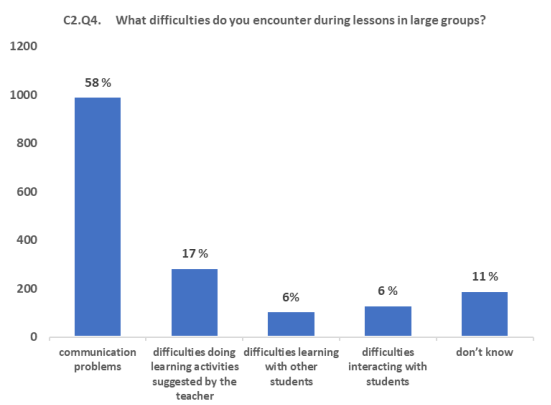
Figure 13. Student survey, difficulties encountered in large groups (question C2.Q4).
The interpersonal relationships are assessed by the questionnaires C2. 58% of the surveyed said that the problem with large groups was communication in general. 17% had difficulties carrying out the assignments and the learning activities proposed by the teachers. 15% have difficulties interacting with other students. 11% have no opinions on these issues (
Figure 13).
The C3 is devoted to gathering students’ opinions on learning in large groups and distance learning.
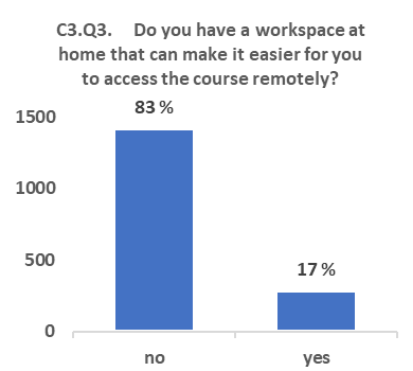
The results show that 83% of the surveyed students do not have an appropriate working environment at home for facilitating distance learning courses (
Figure 14). Most students in this respondent group feel that their home working conditions and environment do not provide the same quality and level of concentration as in classrooms on campus. This was confirmed during the informal interviews, in which the students emphasized the problems and challenges they experienced in the palliative distance learning courses organized by the university during the coronavirus pandemic. The challenged are related to power outages, internet access, and noises in the home environment.
Figure 14. Student survey, working environment and conditions at home (question C3.Q3).
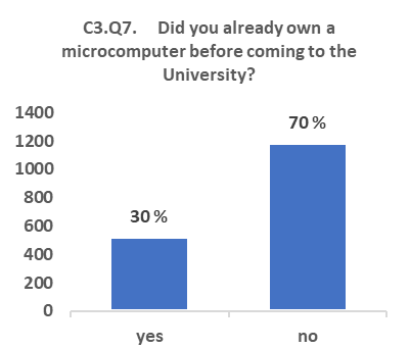
70% of the surveyed did not own a computer before attending university (
Figure 15). Most courses taken before university did not use ICT tools. Most respondents were uncomfortable with distance learning without the presence of a teacher as in initial training, which discourages learning and personal development in the course units offered online. These are some of the additional responses obtained from learners in informal discussions. This is very real when we see the work done elsewhere in e-learning solutions
| [3] | Al Siyabi, M., A. A. Khan, T. Hussain, H. Al Rashdi, and J. R. Pillai. "Evaluating the Impact of E-Learning and Online Assessment on Engineering Education in Oman HEIs during COVID-19: A Mixed-Method Study." Journal of Educational Research and Reviews 12, no. 1 (2024): 1-11. https://doi.org/10.33495/jerr_v12i1.23.143 |
| [8] | Arbaugh, J. B., & Rau, B. A Study Disciplinary, Structural, and Behavioral Effect on Course Outcomes in Online MBA Courses. Decision Sciences Journal of Innovative Education, 2007. 5(1), 65-95. |
| [9] | Hone, K. S. and El Said, G. R. (2016) Exploring the Factors Affecting MOOC Retention: A Survey Study. Computers and Education, 98, 157-168. https://doi.org/10.1016/j.compedu.2016.03.016 |
[3, 8, 9]
.
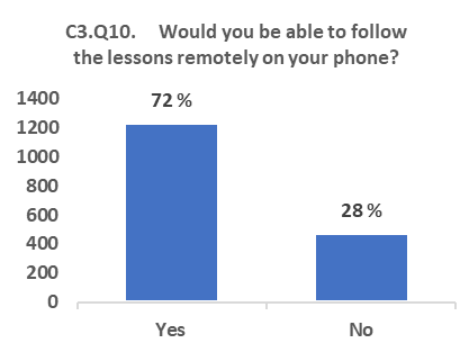
72% believe they can take courses using smartphones, while 28% of the students said they could not. The reasons cited are inadequate user interface (level of user-friendliness) and lack of competence and familiarity with smartphones (
Figure 16). This additional information was obtained informally from students for experiments during the coronavirus pandemic.
Figure 15. Student survey, of those who own a computer prior to university (question C3.Q7).
Figure 16. Student survey, of those who use phones to follow lectures (question C3.Q10).
In summary, for students in large groups at the University of Lomé, attending in large groups is a challenge for which they are unprepared and a major source of demotivation. The results of the surveys show that the solution for managing these large groups must be based on face-to-face lectures and activities on the university campus. It must enable learners to be in more appropriate conditions than where they live. The students surveyed, therefore, reject the distance learning solution, which requires working conditions, environments, and tools that most of them do not have. The solution must provide to them more equitable and inclusive conditions of courses.
6. Conclusion
Massification problems, characterized by classes of 3,000 or more students in the initial enrollment at the University of Lomé, represent a significant challenge for student engagement in terms of performance and participation in academic activities. To address these issues, we conducted an evaluation survey using questionnaires and informal interviews with 1,800 students and 106 teachers. The responses from 86 teachers and 1,702 students identified various characteristics that the University of Lomé needs to address.
The survey results indicate that a degree of face-to-face teaching is essential to mitigate the challenges posed by massification, particularly for large undergraduate classes. The solution should not solely involve teachers recording their lectures without students present, nor should it rely on a distance learning model that fails to allow for monitoring and evaluating student participation. Classrooms should be equipped with automatic recording devices to capture lectures, allowing teachers to reuse these recordings for other groups. The approach must facilitate splitting large groups into smaller ones, ensuring that students remain within their respective groups. Additionally, it should enable teachers to provide students with videoconferencing options that deliver high-quality audio and video without requiring extra effort.
From the students' perspective, the management solution must consider their social, economic, and environmental circumstances. Survey responses indicated that an approach based solely on distance learning is inadequate. Many students expressed feeling demotivated when working in environments where they do not belong to smaller, manageable groups. Entry-level students face several challenges: a) lack of equipment and technological resources to access distance courses; b) insufficient personal workspace at home; and c) inadequate organizational skills to manage the transition from high school education to the more demanding university environment. Furthermore, frequent power outages and expensive Internet access in some regions can hinder students' ability to complete assignments or participate in academic activities outside campus.
It's essential to acknowledge the tension in Togo's socio-economic context between the need to equip young people with essential skills and the capacity to provide large-scale training while maintaining quality. Therefore, the most effective solution must enable students to come to the university campus, where conditions are optimized for face-to-face teaching and interaction with both peers and teachers. This study suggests that the management strategy for large groups should resemble an intelligent classroom system, utilizing ICT tools and innovative technologies at a lower cost to enhance teaching and facilitate access to face-to-face courses on campus.
The proposed solutions address the teaching practices for large groups, a pressing issue faced by many universities in developing countries. Their innovation and relevance are vital, given the widespread nature of these problems across various nations. Ultimately, these solutions aim to transform higher education practices for both students and teachers.
This research introduces a novel IT-based approach to the real-time sharing of educational resources in a networked environment, which has not been previously utilized in higher education. It will present innovative solutions that incorporate emerging technologies such as the Internet of Things, smart classrooms, and artificial intelligence. This approach will enable teachers to effortlessly reuse or replay lectures through automatically recorded and stored video courses.
Abbreviations
ADB | African Development Bank |
AY | Academic Year |
IMF | International Monetary Fund |
UNESCO | United Nations Educational, Scientific and Cultural Organization |
SDGs | Sustainable Development Goals |
SDG4 | Sustainable Development Goals 4 |
Author Contributions
Kossi Tepe: Conceptualization, Investigation, Project administration, Writing – original draft
Yann Verchier: Funding acquisition, Methodology, Validation, Writing – review & editing
Kokou Yetongnon: Formal Analysis, Methodology, Validation, Writing – original draft, Writing – review & editing
Conflicts of Interest
The authors declare no conflicts of interest.
References
| [1] |
Cames info, bulletin d’information, du 25 mai au 1er juin 2018, ISSN 07 96 77 99.
https://www.lecames.org/wp-content/uploads/2018/09/CAMES-INFO-Juin-2018-VF-web.pdf
|
| [2] |
Jézégou, A., La formation à distance: enjeux, perspectives et limites de la formation à distance, Paris édition Harmattan, 1998.
|
| [3] |
Al Siyabi, M., A. A. Khan, T. Hussain, H. Al Rashdi, and J. R. Pillai. "Evaluating the Impact of E-Learning and Online Assessment on Engineering Education in Oman HEIs during COVID-19: A Mixed-Method Study." Journal of Educational Research and Reviews 12, no. 1 (2024): 1-11.
https://doi.org/10.33495/jerr_v12i1.23.143
|
| [4] |
Tepe K., Yetongnon K., The role of ICT in scientific research for sustainable development, jrsul, 08-13 October 2018.
|
| [5] |
Pierre-Jean Loiret, L'université virtuelle africaine, l'enseignement à distance en trompe-l'œil? Distances et savoirs, 2008, 6(2), 187-209.
https://doi.org/10.3166/ds.6.187-209
|
| [6] |
Karsenti, T., & Savoie-Zajc, L. (Dirs.). (2018). La recherche en éducation: étapes et approches (4ᵉ éd.). Montréal: Presses de l'Université de Montréal.
https://doi.org/10.1515/978276063933
|
| [7] |
Mitchell, A. (2014). Online Courses and Online Teaching Strategies in Higher Education. Creative Education, 5(23), 2017-2019.
https://doi.org/10.4236/ce.2014.523225
|
| [8] |
Arbaugh, J. B., & Rau, B. A Study Disciplinary, Structural, and Behavioral Effect on Course Outcomes in Online MBA Courses. Decision Sciences Journal of Innovative Education, 2007. 5(1), 65-95.
|
| [9] |
Hone, K. S. and El Said, G. R. (2016) Exploring the Factors Affecting MOOC Retention: A Survey Study. Computers and Education, 98, 157-168.
https://doi.org/10.1016/j.compedu.2016.03.016
|
| [10] |
Wu, B. and Chen, X. (2017) Continuance Intention to Use MOOCs: Integrating the Technology Acceptance Model (TAM) and Task Technology Fit (TTF) Model. Computers in Human Behavior, 67; 221-232.
https://doi.org/10.1016/j.chb.2016.10.028
(Wu et al., 2017)
|
| [11] |
Margaryan A., Manuela B., Allison L., Instructional quality of Massive Open Online Courses (MOOCs), Computers & Education, Volume 80, 2015, Pages 77-83.
https://doi.org/10.1016/j.compedu.2014.08.005
(Margaryan et al., 2015)
|
| [12] |
Vigliano, Patrick. "Du Campus Virtuel Avicenne au Campus Virtuel Africain de l'UNESCO." In CFM 2009-19ème Congrès Français de Mécanique. AFM, Maison de la Mécanique, 39/41 rue Louis Blanc-92400 Courbevoie, 2009.
|
| [13] |
Haipinge E., Kadhila N., Rethinking A Framework for Contextualising and Collaborating in MOOCs by Higher Education Institutions in Africa, Journal of Learning for Development, (March 2021), Vol. 8, No. 1, pp. 204-220, ISSN: 2311-1550.
|
| [14] |
Erstad, Ola, Susanne Kjällander, and Sanna Järvelä. "Facing the challenges of ‘digital competence’ a Nordic agenda for curriculum development for the 21st century." Nordic Journal of Digital Literacy 16.2 (2021): 77-87.
https://doi.org/10.18261/issn.1891-943x-2021-02-04
|
| [15] |
Tondeur, J., van Braak, J., Ertmer, P. A. et al. Understanding the relationship between teachers’ pedagogical beliefs and technology use in education: a systematic review of qualitative evidence. Education Tech Research Dev 65, 555–575 (2017).
https://doi.org/10.1007/s11423-016-9481-2
|
| [16] |
Blume, C. (2020). German teachers'digital habitus and their pandemic pedagogy. Post Digit Science Education, 2, 879-905.
https://doi.org/10.1007/s42438-020-00174-9
|
| [17] |
Greenhow, C., & Lewin, C. Online and blended learning: Contexts and conditions for education in an emergency. British Journal of Educational Technology, 2021, 52(4), 1301-1305.
|
| [18] |
Oliveira, G., Teixeira, J. G., Torres, A., & Morais, C. An exploratory study on the emergency remote education experience of higher education students and teachers during the COVID-19 pandemic. British Journal of Educational Technolgy, 2021, 52(4), 1357-1376.
https://doi.org/10.1111/bjet.13112
|
Cite This Article
-
-
@article{10.11648/j.ijsts.20251302.14,
  author = {Kossi Tepe and Yann Verchier and Kokou Yetongnon},
  title = {The Challenges of Massification in Higher Education in Developing Countries
},
  journal = {International Journal of Science, Technology and Society},
  volume = {13},
  number = {2},
  pages = {61-72},
  doi = {10.11648/j.ijsts.20251302.14},
  url = {https://doi.org/10.11648/j.ijsts.20251302.14},
  eprint = {https://article.sciencepublishinggroup.com/pdf/10.11648.j.ijsts.20251302.14},
  abstract = {Higher education institutions in developing countries, especially in Africa, face numerous challenges related to the massification of classes due to rapid growth in student enrollment in public universities. This expansion has been encouraged by public authorities, with the support of organizations like the United Nations and UNESCO, to ensure that countries can train qualified professionals and meet their socio-economic needs. However, the increase in student numbers in large classes (with some courses having over 3,000 students) raises significant concerns regarding the quality of education and equity. Issues include resource availability, content reproducibility, study conditions, and access to digital solutions. Providing this type of education requires specialized training conditions and infrastructure, which is often lacking in developing countries. This paper presents the findings of a survey conducted at the University of Lomé, which included 1,800 students and 106 teachers, all of whom experience the challenges associated with large class sizes. The student demographic primarily consists of first-year bachelor’s program entrants. The main objective of the survey is to gather insights and opinions from participants on suitable solutions the University of Lomé can implement to address the challenges of massification when enrollment exceeds 3,000 or 4,000 students. Additionally, the study aims to consider the perspectives of stakeholders in higher education to propose an ICT-based solution for managing large groups effectively. The findings of this research can also be applied to other African universities facing similar challenges and may pave the way for solutions akin to intelligent classrooms for face-to-face courses.
},
 year = {2025}
}
 Copy
|
Copy
|
 Download
-
TY  - JOUR
T1  - The Challenges of Massification in Higher Education in Developing Countries

AU  - Kossi Tepe
AU  - Yann Verchier
AU  - Kokou Yetongnon
Y1  - 2025/04/17
PY  - 2025
N1  - https://doi.org/10.11648/j.ijsts.20251302.14
DO  - 10.11648/j.ijsts.20251302.14
T2  - International Journal of Science, Technology and Society
JF  - International Journal of Science, Technology and Society
JO  - International Journal of Science, Technology and Society
SP  - 61
EP  - 72
PB  - Science Publishing Group
SN  - 2330-7420
UR  - https://doi.org/10.11648/j.ijsts.20251302.14
AB  - Higher education institutions in developing countries, especially in Africa, face numerous challenges related to the massification of classes due to rapid growth in student enrollment in public universities. This expansion has been encouraged by public authorities, with the support of organizations like the United Nations and UNESCO, to ensure that countries can train qualified professionals and meet their socio-economic needs. However, the increase in student numbers in large classes (with some courses having over 3,000 students) raises significant concerns regarding the quality of education and equity. Issues include resource availability, content reproducibility, study conditions, and access to digital solutions. Providing this type of education requires specialized training conditions and infrastructure, which is often lacking in developing countries. This paper presents the findings of a survey conducted at the University of Lomé, which included 1,800 students and 106 teachers, all of whom experience the challenges associated with large class sizes. The student demographic primarily consists of first-year bachelor’s program entrants. The main objective of the survey is to gather insights and opinions from participants on suitable solutions the University of Lomé can implement to address the challenges of massification when enrollment exceeds 3,000 or 4,000 students. Additionally, the study aims to consider the perspectives of stakeholders in higher education to propose an ICT-based solution for managing large groups effectively. The findings of this research can also be applied to other African universities facing similar challenges and may pave the way for solutions akin to intelligent classrooms for face-to-face courses.

VL  - 13
IS  - 2
ER  -
Copy
|
Download





 Share This Article
 Twitter
 Linked In
 Facebook